Banyana Banyana Announce 23-Player Squad for 2027 FIFA Women’s World Cup Play-Offs in Morocco

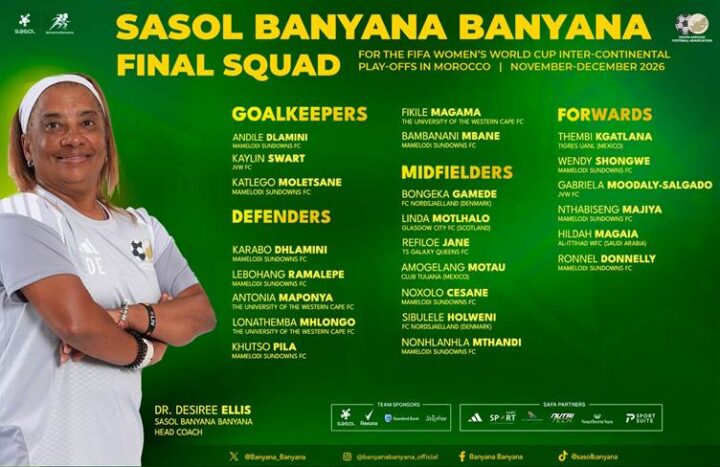
Sasol Banyana Banyana head coach Dr Desiree Ellis has announced her 23-player squad for the upcoming 2027 FIFA Women’s World Cup play-off tournament in Morocco, with South Africa preparing for a crucial opportunity to keep their qualification hopes alive. The mini tournament will take place from 28 November to 5 December 2026 at the Mohammed VI Football Complex in Rabat. South Africa will face Chinese Taipei, Ecuador and Uzbekistan in three important matches as they attempt to secure a place in the final qualification phase. Ellis has retained most of the players who recently represented the country in the Olympic Games qualifiers against Madagascar, where Banyana Banyana recorded back-to-back victories in Bloemfontein. One of the notable inclusions is Denmark-based midfielder Sibulele Holweni, who receives her first national team call-up since moving to Europe last month.
The squad announcement reflects Ellis’ decision to maintain continuity while making adjustments to strengthen the team ahead of the demanding international assignment. Keeping most of the players who featured against Madagascar allows the coaching staff to build on the understanding and confidence developed during those matches. The victories in Bloemfontein also provided a positive foundation as South Africa turn their attention to the challenge of qualifying for the 2027 FIFA Women’s World Cup in Brazil. However, the tournament in Morocco will present a different level of pressure, with every result potentially influencing the team’s chances of progressing. Banyana Banyana will need to combine their recent momentum with consistency and strong performances against unfamiliar opposition.
Holweni’s return to the national team setup is one of the biggest talking points surrounding the squad. The midfielder recently moved to Denmark, marking an important step in her football career as she looks to gain experience in European football. Her selection suggests that Ellis remains interested in monitoring South African players competing abroad and assessing how they can strengthen the national team. Holweni will have an opportunity to reconnect with the Banyana Banyana squad and contribute to an important qualification campaign. Her inclusion also provides another midfield option as South Africa prepare for three closely scheduled matches in Rabat.
Ellis has also explained that several players who were under consideration could not be included because of different circumstances. Exams, injuries and passport issues affected the availability of certain footballers, forcing the technical team to make adjustments when finalising the squad. The coach acknowledged these challenges but expressed confidence in the players selected for the tournament. She explained that the chosen group offers the balance required to compete successfully in Morocco and achieve the desired results. The comments highlight the importance of squad depth and preparation when teams face demanding international competitions. With limited recovery time between fixtures, the availability and fitness of every player could become important factors.
One of the biggest challenges facing Banyana Banyana will be the absence of captain Refiloe Jane for their opening match. The experienced midfielder is suspended for one game after collecting two yellow cards during South Africa’s Women’s Africa Cup of Nations play-off encounter against Nigeria in August. Her absence will be a significant consideration for Ellis because Jane brings leadership, experience and composure to the midfield. The captain’s role extends beyond her technical contribution, as she also provides guidance to younger players during difficult moments. Although she will miss the first fixture, South Africa will need other senior members of the squad to take responsibility and help maintain the team’s organisation. Her availability for subsequent matches will give the technical team another important option as the competition progresses.
South Africa will begin their 2027 FIFA Women’s World Cup play-off campaign against Chinese Taipei on Saturday, 28 November. The match is scheduled to kick off at 16h00 South African time at the Mohammed VI Football Complex in Rabat. The opening encounter is particularly important because a positive result could provide the confidence needed for the remaining fixtures. Ellis has already stressed that the first match will play a major role in determining the team’s direction throughout the tournament. Banyana Banyana cannot afford to underestimate their opponents, especially in a competition where qualification opportunities are limited. A strong start would put South Africa in a better position before facing Ecuador and Uzbekistan.
The second match will see Banyana Banyana take on Ecuador on Tuesday, 1 December, with kick-off scheduled for 21h00 South African time. This fixture could prove decisive depending on the outcome of the opening encounter against Chinese Taipei. Ecuador will present another challenge for Ellis’ players, who will need to manage their energy levels and maintain their tactical discipline. The short turnaround between matches means that recovery, preparation and effective squad rotation could become essential. South Africa will have to approach the game with the same determination regardless of their position in the competition. Securing another positive result would significantly strengthen their hopes of finishing among the two leading teams.
Banyana Banyana will conclude their mini tournament campaign against Uzbekistan on Saturday, 5 December, at 19h00 South African time. By that stage, the team’s qualification prospects could depend heavily on the results of their first two matches. Ellis will want her players to remain focused and avoid allowing the pressure of the tournament to affect their performances. The final fixture could become a must-win encounter if South Africa drop points earlier in the competition. Alternatively, two positive opening results could put the team in a strong position heading into the final match. Regardless of the circumstances, the players will need to approach every game with concentration and a clear understanding of what is required.
Ghana and Papua New Guinea will also participate in the preliminary play-off tournament, adding further competition to the qualification process. Only the top two nations from the mini tournament will progress to the final qualification round scheduled for February 2027. This means that South Africa must finish among the leading two teams to remain in contention for a place at the World Cup. The format leaves little room for mistakes because every match carries significant consequences. Ellis and her technical team will therefore need to prepare carefully for each opponent while ensuring that the players remain physically and mentally ready. The competition will demand consistency rather than relying on one outstanding performance.
Ellis has acknowledged that the play-off route is not the path South Africa originally wanted to take, but she remains focused on securing one of the two available qualification positions. The coach believes the opening fixture will be particularly important because it can establish momentum for the remainder of the competition. She also highlighted the demanding schedule, explaining that matches will come in quick succession with limited time between them. This makes preparation and recovery essential elements of Banyana Banyana’s campaign. A positive opening result would provide the team with confidence and create a stronger platform for the subsequent fixtures. Ellis will be hoping her players understand the importance of starting well and maintaining their concentration throughout the tournament.
The final qualification phase will provide another major challenge for the teams that progress from Morocco. Six nations will compete for the remaining three places at the 2027 FIFA Women’s World Cup in Brazil. The two successful teams from the preliminary play-offs will join four additional representatives, comprising one nation from UEFA, one from CONMEBOL and two from CONCACAF. These six teams will compete in single-match knockout fixtures, making the final stage particularly demanding. Only the three winners will secure qualification for the global tournament. This format means that Banyana Banyana must first navigate the Moroccan play-offs before turning their attention to the possibility of facing another high-level opponent in February.
South Africa’s preparations will begin on 18 November 2026 when the players assemble for national team camp. The squad is scheduled to depart for Morocco the following day, giving Ellis and her technical team time to work on their preparations before the opening fixture. The training camp will provide an opportunity to assess the players’ fitness, establish tactical plans and address any weaknesses identified during previous matches. It will also allow the coaching staff to integrate Holweni and ensure that the squad is fully prepared for the demands of the tournament. With Jane unavailable for the opening encounter, Ellis will also need to consider the best midfield combination to handle the first match. Careful preparation could make a significant difference in a competition where the margin for error is small.
Banyana Banyana now face an important test as they attempt to keep their 2027 FIFA Women’s World Cup qualification ambitions alive. Ellis has selected a largely familiar squad, added Holweni to strengthen her options and acknowledged the challenges surrounding player availability. The suspension of captain Refiloe Jane adds another complication, particularly ahead of the opening match against Chinese Taipei. However, South Africa have the experience and recent results to approach the tournament with confidence. Their immediate objective is to finish among the top two teams in Morocco before pursuing one of the three available World Cup places in the final qualification round. For Banyana Banyana, the campaign represents an opportunity to demonstrate their quality and take another important step towards representing Africa at the 2027 FIFA Women’s World Cup in Brazil.